
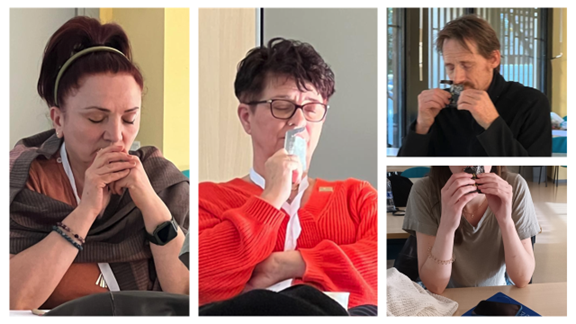
On 21 November 2025, AECED team members, Karine Oganisjana (Latvia), Kardelen Dilara Cazgir (Germany), Uldis Dumins (Latvia) and Sandra Wallenius-Korkalo (Finland), delivered an interactive workshop, “Sensing Democracy-as-Becoming”, in a parallel session at the Conference on Education for Democracy organised by our sister project Democrat at the University of Barcelona.
The workshop introduced participants to four principles of democracy-as-becoming, not only through discussion and conceptual clarification, but also through affective and embodied experience. We invited participants into aesthetic, sensory and movement-based activities so that democracy-as-becoming could be encountered as something lived through bodies, emotions and relations, alongside cognitive understanding.
The workshop structure
Part 1: Cognitive framing
We presented AECED’s interpretation of democracy-as-becoming by introducing the four principles described in Philip Woods’ position paper, “The Four Dimensions of Holistic Democracy”. Each principle was presented on a separate slide, and then the key characteristics were organised into a table to help participants internalise the ideas and apply them more easily in practice.
Part 2: Sensory exploration
In contrast, participants were invited to let their analytical minds rest as much as possible and to “trust the senses”, experimenting with the idea that emotions and bodies are also sources of knowing. One by one, hearing, sight, movement, touch, smell and taste were activated through short tasks.
After each sensory task, participants first made an individual choice about which democracy-as-becoming principle was most strongly evoked, and then explained their reasoning in a short plenary exchange, often noticing that different people experienced the same stimulus in different ways. The variety of interpretations was itself instructive: the same stimulus could be sensed as power sharing, transforming dialogue, or relational well-being depending on what each person noticed in their body, emotions, and memories.
Part 3: Pair compositions
Participants worked in pairs to create a composition that symbolised one democracy-as-becoming principle they wished to express. They could make a collage using provided materials, or combine movement, sound, scent, taste, touch and other elements. When pairs were ready, an “exhibition” began: each pair presented their composition, the rest of the group guessed the intended principle, and the creators then revealed their choice. Participants were also encouraged to notice emotions and bodily responses during the process and to consider which principles they encountered while creating and witnessing one another’s work.
The workshop flow
Part 1: Introducing the principles
The first part focused on engaging participants cognitively with the four principles of democracy-as-becoming and then preparing them to apply them by using the table of key characteristics as a reference point. This set up a common frame for Part 2.
Part 2: Sensing democracy-as-becoming
Hearing
The sensory sequence began with audition. Participants closed their eyes to reduce distraction and listened to Karl Jenkins’ “Palladio: I. Allegretto” (https://www.youtube.com/watch?v=FKgpeVl7yXk). We encouraged them to allow the music to resonate throughout their whole body, giving their mind permission to rest.
When the music ended, participants opened their eyes and voted for the principle the piece had evoked most strongly. About one-third chose power sharing. They described how the different sections of the string orchestra seemed to take turns leading and following, or to blend into a strong collective voice where no instrument was ignored, and every sound contributed to the whole.
Those who chose transforming dialogue heard the piece as an exchange among voices: a musical “conversation” in which different parts spoke, responded and listened, gradually moving toward mutual understanding and then a sense of common ground that could energise joint action.
Others associated the piece with relational well-being. They heard harmony and balance across the sounds: confidence without domination, connection without loss of individuality, and a feeling of being carried together by an atmosphere of strength and steadiness.
Participants noted that even this short activity revealed how aesthetic experience can add nuance and depth to understanding that is difficult to reach through purely cognitive learning. Several recognised the process itself as holistic learning in action.
Vision
Next, participants watched the farewell ceremony for the Tokyo 2020 Paralympic Games as part of the symbolic handover to Paris 2024, led by French dancer, choreographer and artistic director Sadeck Waff together with his performing collective, Geometrie Variable (https://www.youtube.com/watch?v=ekibVX3gK5Q). Participants were struck by the synchronised movements of the 126 performers and the clarity and precision of the choreographer’s gestures.
One participant linked the performance to relational well-being. She described an embodied narrative of liberation, which included performers in wheelchairs. In her interpretation, the performers’ hand movements suggested opening the eyes to see, opening the ears to hear, and removing locks from the mouth in order to speak freely. This, she said, lifted spirits and culminated in hands reaching upward in gratitude for a new state of both personal and relational well-being.
Other participants associated the performance with power sharing, emphasising the inclusion and visible significance of every performer. Whether leading or following, no one appeared less important, and responsibility for the whole performance seemed distributed across the group.
Transforming dialogue was also named, arising from the respectful exchange of self-expression between Sadeck Waff and the collective, and within the collective itself. Even without speech, participants perceived mutual understanding and coordinated response, culminating in a collective artistic salute that welcomed the Paris 2024 Paralympic Games and athletes.
Two participants explicitly connected this segment to holistic learning. They felt that a great deal was conveyed without traditional learning through speaking and reasoning: bodily expression carried meaning and emotion that complemented and expanded conceptual understanding.
Movement
We then invited participants to engage in movement directly. In pairs, one person moved slowly while the other mirrored the partner’s movements. They switched roles and finally improvised together. The activity was brief, but it deepened the atmosphere of trust that had been established earlier. The room became more relaxed and friendly, with smiles, laughter, and focused attention shared across pairs.
Participants described relational well-being through the sense of connection and empowerment that emerged when bodies attuned to one another. Power sharing was evident in the alternation of leading and following, grounded in respect for each partner’s choices and comfort. Transforming dialogue appeared in the open exchange of ideas through gesture, the deep listening required to mirror, and the mutual adjustment needed to co-create a shared improvisation.
Several participants again highlighted holistic learning: not only did embodied action help create a democratic atmosphere, but it also generated new emotional and bodily knowledge about how democratic relationships can be cultivated in practice.
Touch
For tactile exploration, participants closed their eyes and slowly stroked the surface of their conference badges. We asked them to focus on texture, temperature and resistance, attending to sensation rather than interpretation. Compared to the hearing and vision activities, this task proved more challenging to connect directly with democracy-as-becoming principles, resulting in fewer comments.
One participant shared that, while touching the badge, she immediately thought about the conference itself and associated it with transforming dialogue, because the conference provided open and respectful exchange, welcomed diversity, sought common ground and aimed for shared action for the greater good. We noted that the phrasing “I thought” revealed how readily cognition returns: rather than the tactile qualities evoking a principle directly, the object triggered an associative idea about its context.
From my perspective, the smooth, even surface of the badge evoked a sense of relational well-being. The sensation of balance and evenness brought a feeling of calm and connection, as if “being myself” and “being with others” could coexist without friction.
Smell
Next, participants were given small bags of coffee. They opened them, closed their eyes, and inhaled the scent, focusing on the aroma and the emotions it evoked while again trying to quiet the analytical mind.
One participant responded immediately:
“In all the gatherings I have organised for my colleagues, coffee and its aroma are always inseparable from our discussions. So, the smell of coffee is the basis for relational well-being, as it opens hearts and minds toward each other, connects people, and empowers them to think together and feel that they belong to the group”.
We also shared that, before the conference, our team had carefully discussed scent choices due to allergies. Participants were warned that if they were sensitive to coffee smell, they should skip this exercise. A more unusual scent might have evoked different associations, but we opted for a familiar, widely accepted option to minimize risk.
Taste
Finally, participants closed their eyes and savoured strawberry-mix Tic Tac drops, focusing on layers of flavour and the emotions these evoked. Choosing a taste required care: we ruled out fruit-and-nut bread (gluten, lactose, and nut allergies) and many sweets (diabetes and insulin resistance). The tiny drops were familiar, optional, and unlikely to harm.
Participants offered fewer associations than with sound, vision and movement. One participant linked taste to power sharing: first, strawberry sweetness led; then a sour note dominated; and finally, the flavours merged so both could be experienced at once.
We concluded that all senses – hearing, vision, touch, smell, and taste, together with movement, deepened understanding of democracy-as-becoming. Yet not all modalities evoked equally rich associations: hearing and vision often generated more detailed connections than touch, smell, and taste, perhaps because sound and image more readily carry narrative and relational structure. Still, quieter modalities sometimes surfaced subtle, personal meanings, showing how embodied knowing can be intimate, contextual, and hard to articulate.
Part 3: Compositions and exhibition
Participants then formed pairs and chose which democracy-as-becoming principle they wanted to express. Using the materials provided, and sometimes incorporating movement or sound, they created their compositions. Despite the limited time, the outcomes were highly original.
A pair, consisting of a man and a woman, presented a wordless drama. Without speaking, they used vivid facial expressions and expressive hand and body gestures to convey an intense exchange that ended with a handshake and smiles. A spectator immediately exclaimed, “Transforming dialogue!” The performers nodded. Watching, I felt as if I were witnessing a short professional theatre scene.
Later, during a World Cafe hosted by AECED colleagues Susanne Maria Weber and Pilvikki Lantela, I happened to sit in the same group as Laurence, the male performer. I told him that the performance had seemed professional. He smiled and explained that he was, in fact, a professional actor from the northern part of Catalonia. It was an unexpected surprise hidden in our small workshop community.
The second pair used a ball of yarn. They tied one end to the leg of a desk, then threw the yarn back and forth, each time fastening it to different objects. Finally, they threw the yarn toward the other participants who were watching, drawing them into the growing web. The composition clearly illustrated power sharing: connections are multiplied, responsibility is spread, and the “network” only exists through mutual participation.
Another pair met at the front of the room and began passing a napkin between them while slowly turning and circulating around each other in changing formations. Observers described the piece as combining power sharing (as the napkin moved back and forth and leadership shifted) and transforming dialogue (as the pair negotiated rhythm, distance and timing without words).
Another pair created a circular collage. They drew community members of different ages – children, middle-aged adults and older adults – to represent diversity across the lifespan. They pierced the paper in several places and threaded red yarn through the holes, leaving two ends hanging. Their collage expressed relational well-being: the thread symbolised that all members are interconnected, and that belonging can generate happiness, confidence and empowerment.
Because the conference programme moved quickly, there was little time for extended reflection after the exhibition. Still, the highly engaged atmosphere and participants’ requests to receive the presentation indicated a strong interest. We shared that we would analyse the workshop and write a blog post, and that participants could find this and other AECED materials on the AECED website. During breaks and other conference activities, our team also received positive feedback.
Reflections on the workshop
After the event, several colleagues shared brief reflections that helped us view the workshop from different perspectives.

Dr. Hanife Akar
Full Professor of Educational Sciences, Middle East Technical University, Ankara, Türkiye.
Art by itself is a healing action. The workshop creatively connected our being and existing among others, and using all our senses to feel unique in one way and to appreciate the uniqueness of being together and acting together with the other as “us.” Thank you for sharing this moment of creative action and going through our “inner self and being together.”
Kardelen Dilara Cazgir
kardelen.cazgir@uni-marburg.de
PhD Fellow, Philipps University Marburg, Germany
When we designed the workshop, I held space for uncertainty – turnout, participants’ experience with embodied learning, and their openness to sensing democracy through bodies, emotions, and relationships. On the day, I paid close attention to sound and atmosphere and was moved by how openly participants engaged each activity, letting the cognitive mind rest and making meaning in embodied, relational ways. What stayed with me most was seeing democracy-as-becoming emerge through our co-becoming – listening, mirroring, sharing sensations, and reflecting with care. I’m grateful to the participants and my colleagues; together we created a space where democratic learning unfolded through presence, sensation, and connection.

Sandra Wallenius-Korkalo
sandra.wallenius-korkalo@ulapland.fi
Collaborative Investigator in AECED, University Lecturer, University of Lapland, Finland
Sandra has shared the following short text recollecting her embodied experiences for her reflection on the workshop:
“As I open the door to the lecture hall assigned for us, I’m struck by two things: a barrier of cool air of the unheated room, and the golden yellow sunlight beaming bright between the window blinds. Shivers run up my arms. Anticipation, excitement, anxiety, coursing through me. Deep breath, deep breath, syncing with another. Pushing a heavy table off the wall, feeling the various objects in my fingertips, the rough yarn, slick balloons, cold metal of scissor blades. Hearing my colleagues speaking, seeing them listening, engaging. Tensions melting from my shoulders. Smell the coffee, taste the candy – is it gluten-free? Quick swipe on the phone of fellow sufferer ensures the welfare of our guts. Moving with, mirroring, following. Taking a step back. Marvelling at immersion and commitment. Sensing the room come together. Tik tok, tik tok, time is running out. Let’s rush to share, there is still so much to convey. The room feels warm now. Heating must have worked.”

Uldis Dūmiņš
Scientific Assistant, Riga Technical University, Latvia
As a civil society practitioner, I value experiencing democracy rather than merely discussing it. I expected an engaging session, but the lived atmosphere of trust and openness was even more powerful than I imagined. The workshop reaffirmed for me that democracy is something we can feel and live through our senses, emotions, and embodied presence, depending on what we understand cognitively.
Karine Oganisjana
Professor, Dr. Pedagogy and Leading Researcher, Riga Technical University, Latvia
For me, this workshop was unusual because we didn’t ask participants to voice opinions or make judgements about democracy. Instead, we invited them to explore themselves, activate their senses, notice what emerged in their bodies, and link those experiences to the principles of democracy-as-becoming. Petra van Haren, Director of ESHA (European School Heads Association), even offered to share AECED’s work in an article for ESHA HEADlight magazine.
I’m deeply grateful to my AECED colleagues – Kardelen, Uldis, and Sandra – and to all participants for their openness. I hope this approach encourages further experimentation with democratic learning as an embodied, relational practice.
About us
The AECED project is Horizon Europe and UKRI-funded and promotes aesthetic and embodied learning to help educators inspire democratic values like empathy, fairness, active citizenship and inclusion. Aesthetic and embodied learning can be thought of as learning through art, movement, and emotion – what affect do you feel from the activity? What’s your response to it? Aesthetic learning involves the senses. Embodied learning acknowledges that learning is not just a cognitive process but also a physical one, deeply connected to the body’s sensations, movement, and perception.
The AECED project aims to enhance the role of aesthetic and embodied learning across all phases of education and organisational learning and has project partners in the UK, Croatia, Finland, Germany, Latvia and Portugal.
If you are an educator or have an interest in education policy or citizenship you can tell us how you’d like to be involved or kept informed about other AECED events, please scan the QR code to register your interest in the project or complete this short form , or visit www.aeced.org to find out more about us.
Blog by Karine Oganisjana, Riga Technical University, Latvia
#Education4Democracy