
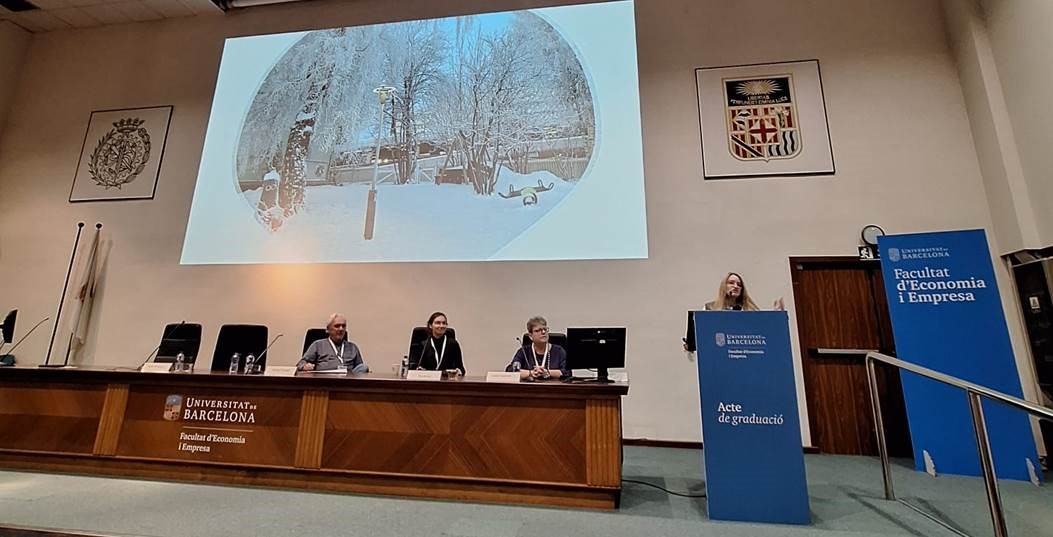
In the beginning of our AECED project, we were placed within a cluster of three projects that had responded to the same Horizon Call, namely ‘Reshaping democracies’ (Horizon-CL2-2022-Democracy-01). As I was new to Horizon, I didn’t quite know what this collaboration between the three sisters – as the projects were collectively called – would look like. I sensed questions in our consortium – how collaboration would benefit our project? How would we handle this “extra work” on top of all deliverables, research, meetings and other things?
Over the course of nearly three years of project work the collaboration has materialised in several meetings, conference presentations and symposia, joint policy ideas paper and roundtable, and a joint academic book in the making. This work has been dispersed among various agents, project coordinators and individual researchers alike – many joint events would not have taken place without the active involvement of efficient researchers from different projects.
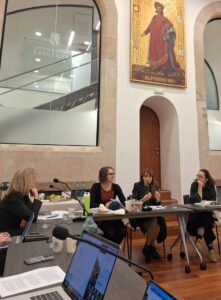
The last concrete and materialised point of collaboration took place in November 2025 in Barcelona, when our Democrat sister project held its final consortium meeting in the form of the Democrat conference. Critical Change Lab and AECED were invited and included in the planning phase as Democrat’s sisters. Moreover, on the morning before the actual conference, we held a joint policy roundtable in which various European policy actors discussed the policy ideas formulated by the three sisters. To get the most out of the discussion, a joint policy recommendations paper was produced in advance. Through this process, the three sisters discussed and negotiated on what were the main policy topics to raise and to present as a united front.
One of these was the holistic approach to education for democracy. All three projects connect democracy to everyday democratic experiences and practices of citizens – democracy is not only about voting or learning about the institutions that foster democracy, but it’s about living together with other people and the broader environment; it’s about everyday decision-making and thinking about whose voice matters when choices are considered and decisions made. Democracy happens in schools, in recreational groups, in families through everyday encounters that provide opportunities to experience, learn and foster democracy.
Our focus to promote aesthetic and embodied learning in education for democracy is a novel approach. It’s not only about understanding emotions in a learning process or adding a creative touch to more traditional classroom teaching. It’s about acknowledging that we truly learn, through not just the cognitive, but through our senses, our bodily sensations, affects, and through all sorts of creative experiences that relate also to the intuitive side of being a human. This kind of learning can teach us a great deal about democracy, and these kinds of experiences can take place in nearly any educational setting, not only in civic education classes. Through discussing and comparing, debating and clarifying concepts and approaches, we as the AECED project have understood more clearly the main added value of our project’s focus. Moreover, feedback from sisters has challenged us to articulate our main idea even more clearly.
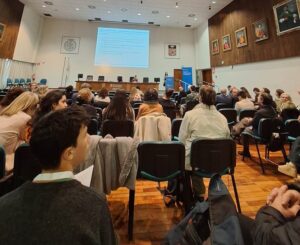
For me personally, the two days in Barcelona, and the joint policy roundtable especially, reconfirmed the strength of working together – there’s inherent joy in working alongside talented people, but together the message to the broader audience can be more impactful. Collaboration can be an academic “cross-fertilization” in which one project’s or even an individual researcher’s work is strengthened by exchanging and discussing ideas. However, in comparing and communicating your project work with other projects, you also get a clearer idea of who you are and what is the added value and message of your project.
About us
The AECED project is Horizon Europe and UKRI-funded and promotes aesthetic and embodied learning to help educators inspire democratic values like empathy, fairness, active citizenship and inclusion. Aesthetic and embodied learning can be thought of as learning through art, movement, and emotion – what affect do you feel from the activity? What’s your response to it? Aesthetic learning involves the senses. Embodied learning acknowledges that learning is not just a cognitive process but also a physical one, deeply connected to the body’s sensations, movement, and perception.
The AECED project aims to enhance the role of aesthetic and embodied learning across all phases of education and organisational learning and has project partners in the UK, Croatia, Finland, Germany, Latvia and Portugal.
If you are an educator or have an interest in education policy or citizenship you can tell us how you’d like to be involved or kept informed about other AECED events, please scan the QR code to register your interest in the project or complete this short form , or visit www.aeced.org to find out more about us.
Blog by Pilvikki Lantela, AECED project manager, from University of Lapland
#Education4Democracy