
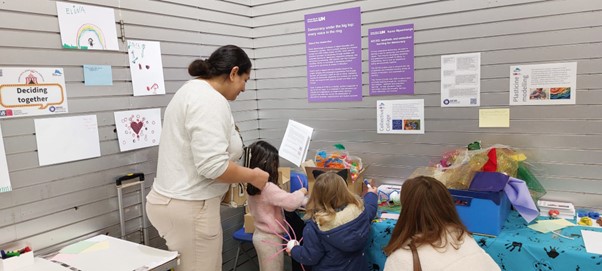
As part of the UK-wide Economic and Social Research Council (ESRC)’s Festival of Social Science 2025 – a free pop-up event exploring the realities of juggling modern life – the AECED UK team invited visitors to The Howard Centre in Welwyn Garden City to try some creative activities to help them explore, feel, experience and reflect on democratic values such as empathy, fairness, and inclusion, and how these values might impact on their everyday life at school, work, or home.
The event took place toward the end of the half-term week and provided visitors of all ages with a choice of activities, with a short prompt to shape their experience. The prompts – being included, deciding together, looking out for others, being heard, fairness – were changed every hour and sparked interesting conversations and approaches to both choosing an activity and actually doing that activity.

There were four activities available – collective collage, drawing, sculpting with plasticine, and movement – the common purpose was for visitors to use the activities to express a response to one of the five prompts. These activities reflect some of the aesthetic and embodied learning for democracy approaches that feature in the AECED resources used across the six partner countries in their research trials. These resources were aimed at practitioners across all phases of education, including organisational learning, and comprised a conceptual Framework, practical Guides to Practice and example activities to tailor to individual contexts or to inspire the practitioner to create their own. These exciting resources will soon be freely available on our website.
Being included
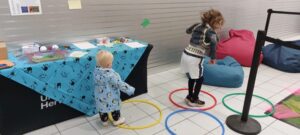
Two siblings worked side by side to produce artwork in response to the prompt “being included”, with one producing a heart in contrasting colours with flowers growing out of the heart’s border to represent the feeling of being included and the other drawing a happy cat because being included made them feel happy. They followed this with an energetic game of jumping between hoops as that was a game that both could enjoy.
*All photographs are shared here with permission from both the individual subjects and their responsible adults
One young visitor chose to use the plasticine to represent their thoughts about being included, and carefully made a stack of one of each colour of the modelling material, applying firm pressure when assembled to make sure that the stack was no longer just separate pieces of modelling clay.
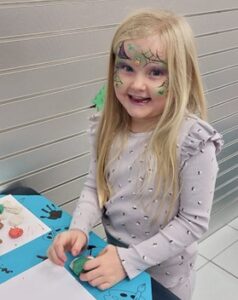
This prompt provoked lots of conversation, as visitors first decided if they were going to work together on an activity or work independently. It was great to see discussion happening across families and friends to first make this decision and to then perform the activity.
Looking out for others
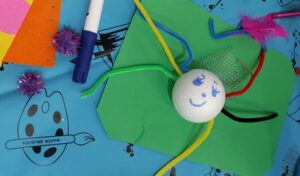
This prompt seemed a trickier one for visitors to immediately respond to, which allowed some intergenerational discussion as to what looking out for someone might feel like or involve. You may have already noticed from the cobweb themed face paint in the second photograph in this blog that the festival coincided with the run up to Halloween. During the looking out for others prompt, several spiders were created from crafting materials, with help being given by the more capable crafters to those struggling to assemble legs and body.
Being heard
The being heard prompt tied in with the theme of the “every voice in the ring” workshop and the AECED tagline adopted for the event of “every voice, every action, every day”. Democracy doesn’t just mean voting in elections but also acting democratically in our everyday lives – in communities, families and in work, including your own and others’ voices being heard.
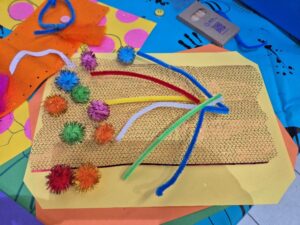
Below is a collage that one of the researchers made to reflect her feelings about being heard.
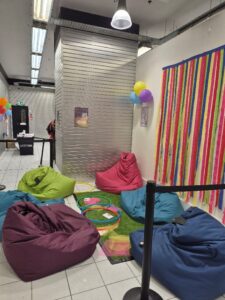
You will see in the image that follows some hoops and scarves with which visitors were invited to use movement to connect with the same prompts as were used for the other activities. This area, adjacent to the drawing, collaging and sculpting activities, included a number of bean bag chairs, which gave a safe space to a number of different groups of teenage visitors over the two days to voice their opinions and make plans. Some were very clued in to the idea of democracy, and could see how the practice of everyday democracy was important. Others felt they lacked a voice in both their home and school environments.
Fairness
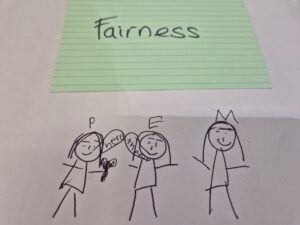
In response to this prompt, one six-year-old visitor quickly drew three figures, with an item being passed from one to another and speech bubbles saying, “Here” and “Thanks!” – a very concise and effective way to demonstrate the value visually and it was inspiring to see this concept grasped so easily by one so young.
The short prompts used were effective in either facilitating a creative output or sparking conversation, both of which were equally valued. Some visitors chose just one activity, some chose two or three, and some chose to sit in the bean bag chairs and just talk.
We welcomed over 110 visitors to our stand, including parents, grandparents, pre-school and school-age children, teenagers, and young people. This was a diverse and engaged audience. The two days sped by and the AECED UK team send their thanks to the both the ESRC and the Impact team at the University of Hertfordshire for including and supporting them in this wonderful event.
About us
The AECED project is Horizon Europe and UKRI-funded and promotes aesthetic and embodied learning to help educators inspire democratic values like empathy, fairness, active citizenship and inclusion. Aesthetic and embodied learning can be thought of as learning through art, movement, and emotion – what affect do you feel from the activity? What’s your response to it? Aesthetic learning involves the senses. Embodied learning acknowledges that learning is not just a cognitive process but also a physical one, deeply connected to the body’s sensations, movement, and perception.
The AECED project aims to enhance the role of aesthetic and embodied learning across all phases of education and organisational learning and has project partners in the UK, Croatia, Finland, Germany, Latvia and Portugal.
If you are an educator or have an interest in education policy or citizenship you can tell us how you’d like to be involved or kept informed about other AECED events, please scan the QR code to register your interest in the project or complete this short form , or visit www.aeced.org to find out more about us.
Blog by Philippa Mulberry of AECED UK and University of Hertfordshire
#Education4Democracy