
Embodying Democracy: A Framework for Aesthetic and Embodied Learning for Democracy
We are pleased to share that the AECED project will be hosting a free online launch webinar to introduce our newly developed Pedagogical Framework and Guides to Practice.
Date: Wednesday, 4th March 2026
Time: 10:30–12:30 CET / 09:30-11:30 UK time (120 minutes)
This 120-minute event will explore how aesthetic and embodied learning for democracy, or AELD for short, can respond to pressing challenges in education for democracy today.
Grounded in research and developed through collaboration with educators, practitioners, and organisations across Europe, the AECED Framework and Guides to Practice offer practical approaches for use across all phases of education, as well as in professional and organisational learning contexts.
What to expect
The webinar will combine insight, experience, and dialogue. Participants will:
- Gain an overview of the AECED Pedagogical Framework and its key ideas, including aesthetic and embodied learning, responsive pedagogy, and democracy-as-becoming
- Explore how the Framework and Guides to Practice can be used in diverse educational and organisational settings
- Take part in a short experiential aesthetic and embodied activity
- Hear from project partners, practitioners supporting the use of the guides, and early adopters already putting the resources into practice
- Contribute questions to a panel discussion including policy and practice perspectives
This event is aimed at national, regional, and local organisations across Europe, as well as educators, practitioners, researchers, and all those with an interest in education for democracy. It will be in English.
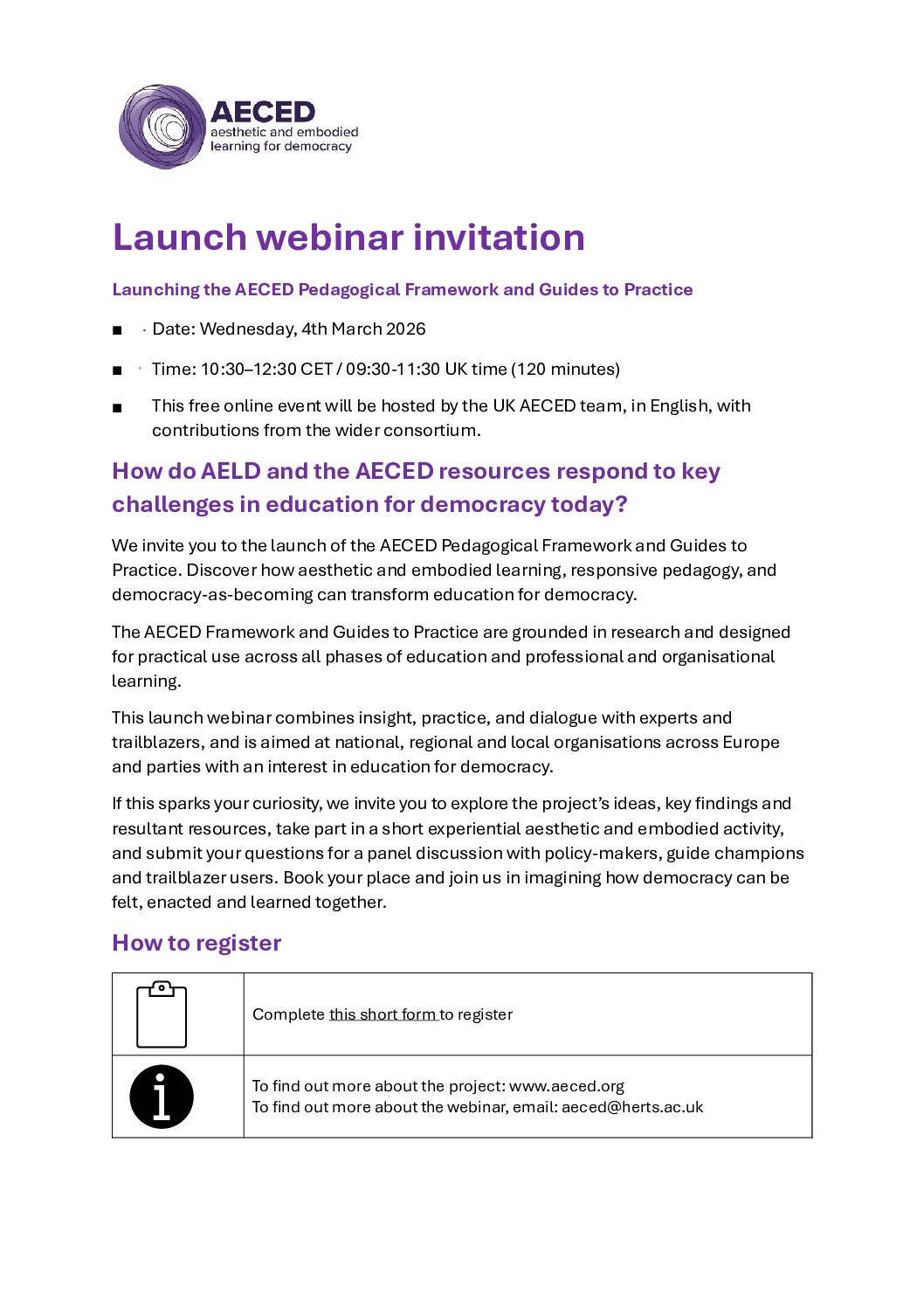
Click this link to secure your place – we look forward to seeing you: Register here
About us
The AECED project is Horizon Europe and UKRI-funded and promotes aesthetic and embodied learning to help educators inspire democratic values like empathy, fairness, active citizenship and inclusion. Aesthetic and embodied learning can be thought of as learning through art, movement, and emotion – what affect do you feel from the activity? What’s your response to it? Aesthetic learning involves the senses. Embodied learning acknowledges that learning is not just a cognitive process but also a physical one, deeply connected to the body’s sensations, movement, and perception.
The AECED project aims to enhance the role of aesthetic and embodied learning across all phases of education and organisational learning and has project partners in the UK, Croatia, Finland, Germany, Latvia and Portugal.
If you are an educator or have an interest in education policy or citizenship you can tell us how you’d like to be involved or kept informed about other AECED events, please scan the QR code to register your interest in the project or complete this short form , or visit www.aeced.org to find out more about us.
#Education4Democracy