
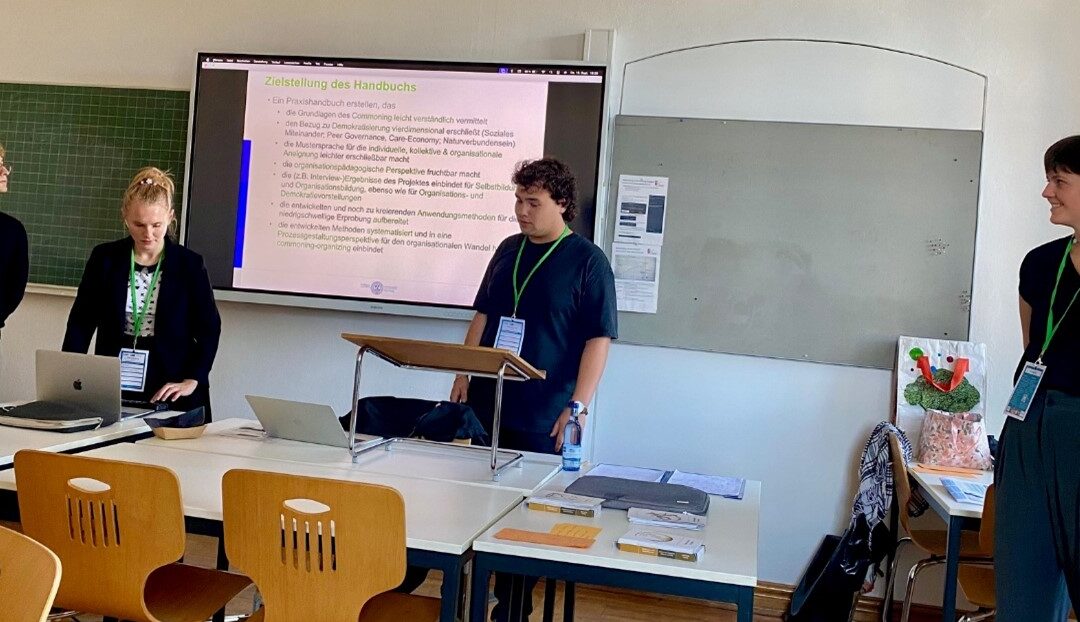
In September 2025, we (the AECED German Team from Philipps University Marburg) participated in a conference on political education, sustainability, and transformation at the University of Education Weingarten, together with a third research intern and a research colleague. University. As part of the AECED team, we helped facilitate a practice-oriented workshop exploring how the Pattern Language of Commoning can be combined with embodied learning.
As a team, we took part in the “Market of Possibilities”, similar to a poster presentation, which gave us the opportunity to connect with diverse participants regarding our project. In addition, we joined the ad hoc Barcamp sessions, where we presented a practice-oriented workshop. In the workshop, first we presented the different multimodal products of the students’ collaboration, the hybrid Commoning practice handbook with its method-videos and the Pattern Language of Commoning cards introductory audio-clips. The practical part of the workshop focused more on the Pattern Language of Commoning cards, which were used as a methodological tool to create a space for reflection and open exchange. The exercise for the participants consisted of developing ideas on how commoning could sound. This exercise gave the participants an opportunity to experience how we tried to develop a Commoning corporate design for sound and visuals. Through the short practical exercise, it became tangible how the Pattern Language of Commoning cards can support sustainable education and its related processes.
The feedback from the participants showed that the use of the Commoning cards in ESD contexts holds great potential – both for reflecting on one’s own practice and for developing new forms of collective learning. At the same time, the discussions opened valuable perspectives for further developing our approach, particularly regarding organisational development and teaching design.
Participating in the conference enabled us to reflect on the current results of the AECED project within a broader professional context, to integrate many new perspectives, and to incorporate important insights from academic practice.
About us
The AECED project is Horizon Europe and UKRI-funded and promotes aesthetic and embodied learning to help educators inspire democratic values like empathy, fairness, active citizenship and inclusion. Aesthetic and embodied learning can be thought of as learning through art, movement, and emotion – what affect do you feel from the activity? What’s your response to it? Aesthetic learning involves the senses. Embodied learning acknowledges that learning is not just a cognitive process but also a physical one, deeply connected to the body’s sensations, movement, and perception.
The AECED project aims to enhance the role of aesthetic and embodied learning across all phases of education and organisational learning and has project partners in the UK, Croatia, Finland, Germany, Latvia and Portugal.
If you are an educator or have an interest in education policy or citizenship you can tell us how you’d like to be involved or kept informed about other AECED events, please scan the QR code to register your interest in the project or complete this short form , or visit www.aeced.org to find out more about us.
Blog by Leon Meraskentis and Vero Pinzger of AECED Germany and Philipps University Marburg
#Education4Democracy